Decisions

How I make engineering decisions that remain correct years later.

Good decisions are not about choosing technologies. They are about balancing business value, technical constraints and long-term ownership.

Decision Principles

Business first

Explicit trade-offs

Ownership matters

Validate assumptions

Simple over clever

Reversible when possible

Decision Framework
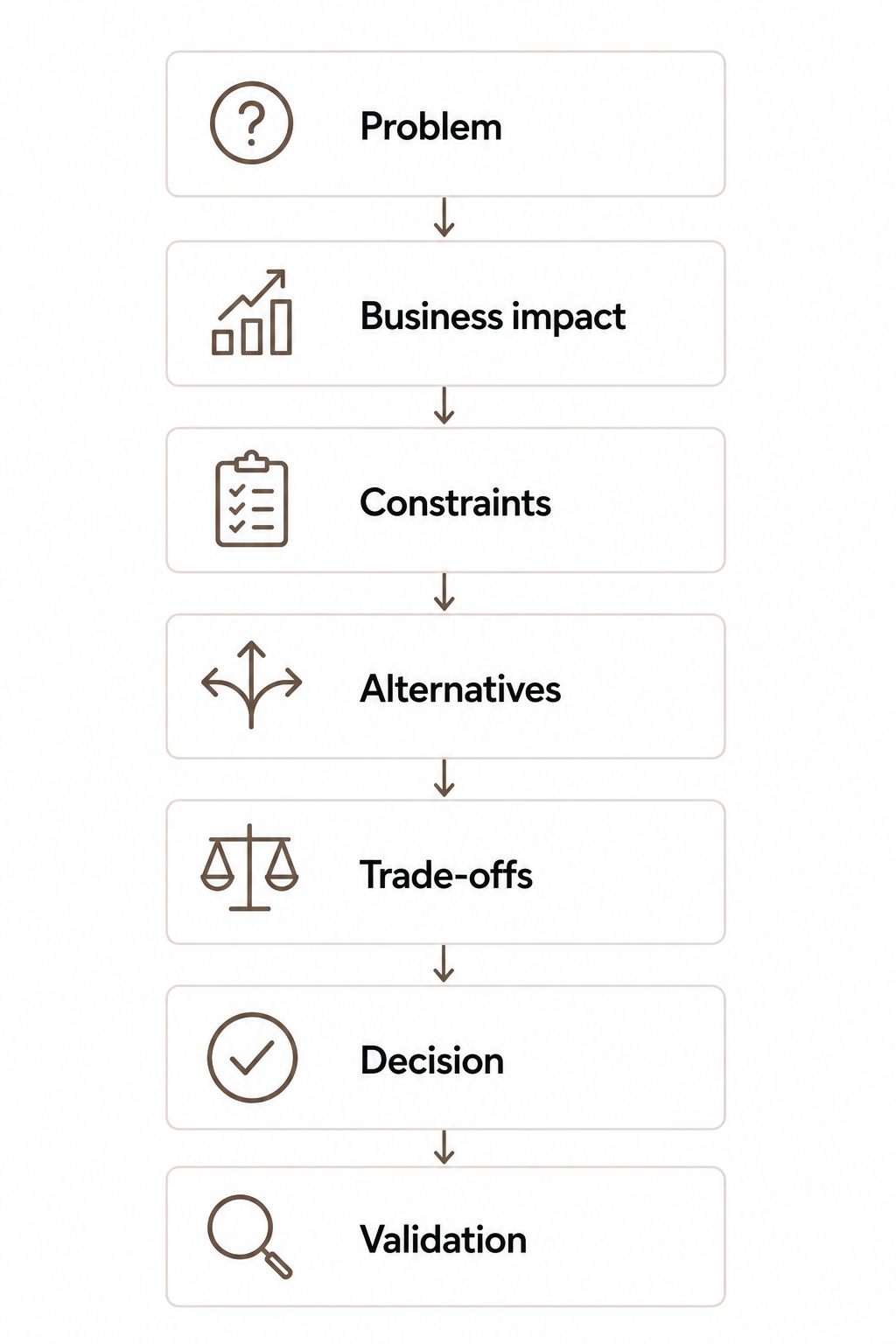
Decision framework: problem, business impact, constraints, alternatives, trade-offs, decision, validation

Every engineering decision follows the same process.

I never start from technology.

I start from the business problem, identify constraints, evaluate alternatives and choose the solution that creates the best long-term outcome.

Technology changes. Decision quality should not.

Engineering Decisions

System Architecture

Layered Architecture

Why controllers, services, repositories and DTOs were separated into explicit application layers.

Read →

Repository Pattern in Yii2

How persistence was isolated from business services in a Yii2 application.

Read →

DTO-Centric Design

Why immutable DTOs became the contract between controllers, services and repositories.

Read →

API Versioning Strategy

How enterprise APIs evolved without breaking existing clients.

Read →

Domain Events

How modules communicate without turning the platform into a dependency graph.

Read →

Universal Inbox

How multiple communication channels were unified behind one conversation model.

Read →

Storage Abstraction

Why file handling was hidden behind a unified storage layer.

Read →

Recurring Tasks Engine

How recurring operational work was automated without duplicating task logic.

Read →

Analytics Pipeline

How operational data was separated from analytical processing and reporting.

Read →

Calendar Synchronization

Why calendar sync became its own domain with separate ownership and integration rules.

Read →

Isolated WebSocket Service

Why realtime communication was extracted from the rest of the platform.

Read →

Queue-Based Background Processing

Why asynchronous jobs became the default mechanism for integrations and long-running work.

Read →

Service Boundaries

How responsibilities were split between services without creating accidental duplication.

Read →

GraphQL vs REST

How client application needs shaped API design across web, mobile and operational tools.

Read →

CI/CD Standardization

How deployment consistency was enforced across a growing set of services.

Read →

Decoupling Legacy Through Events

How business events were used to separate legacy runtime from new platform responsibilities.

Read →

Event-Driven Communication

Why asynchronous message handling replaced synchronous gateway delivery.

Read →

Channel Abstraction

How SMS and WhatsApp delivery were unified without coupling workflows to providers.

Read →

Reliable Delivery Pipeline

How notification processing was split into stages for throughput, retries and observability.

Read →

Template Synchronization

Why template management was moved out of runtime delivery paths.

Read →

Legacy Modernization

How the Strangler Fig pattern reduced delivery risk while moving production responsibilities.

Read →

Modern Services with Legacy Systems

How a new Yii2 API-first service coexisted with a Yii1 application and shared database.

Read →

Asynchronous Export Pipeline

How large PDF generation was moved out of request-response flows into background workers.

Read →

Producer-Consumer Separation

Why export creation remained in business systems while the export service stayed a pure consumer.

Read →

Chunked HTML Rendering

How rendering batches reduced Chromium overhead for large export workloads.

Read →

Parallel Rendering Pipeline

How bounded concurrency reduced rendering time while preserving output order.

Read →

Zero-Copy Local Processing

Why local PDF sources were processed directly instead of being copied through the pipeline.

Read →

Progress Reporting Without Coupling

How workers exposed progress without depending on frontend communication paths.

Read →

Storage Path Abstraction

How shared storage conventions replaced absolute filesystem assumptions across services.

Read →

Stateless Worker Design

Why background workers were made disposable and horizontally scalable.

Read →

Failure Isolation

How export failures were isolated so one broken document could not block other jobs.

Read →

Designing for Horizontal Scaling

How export throughput was designed to grow by adding workers instead of changing architecture.

Read →

Trade-offs

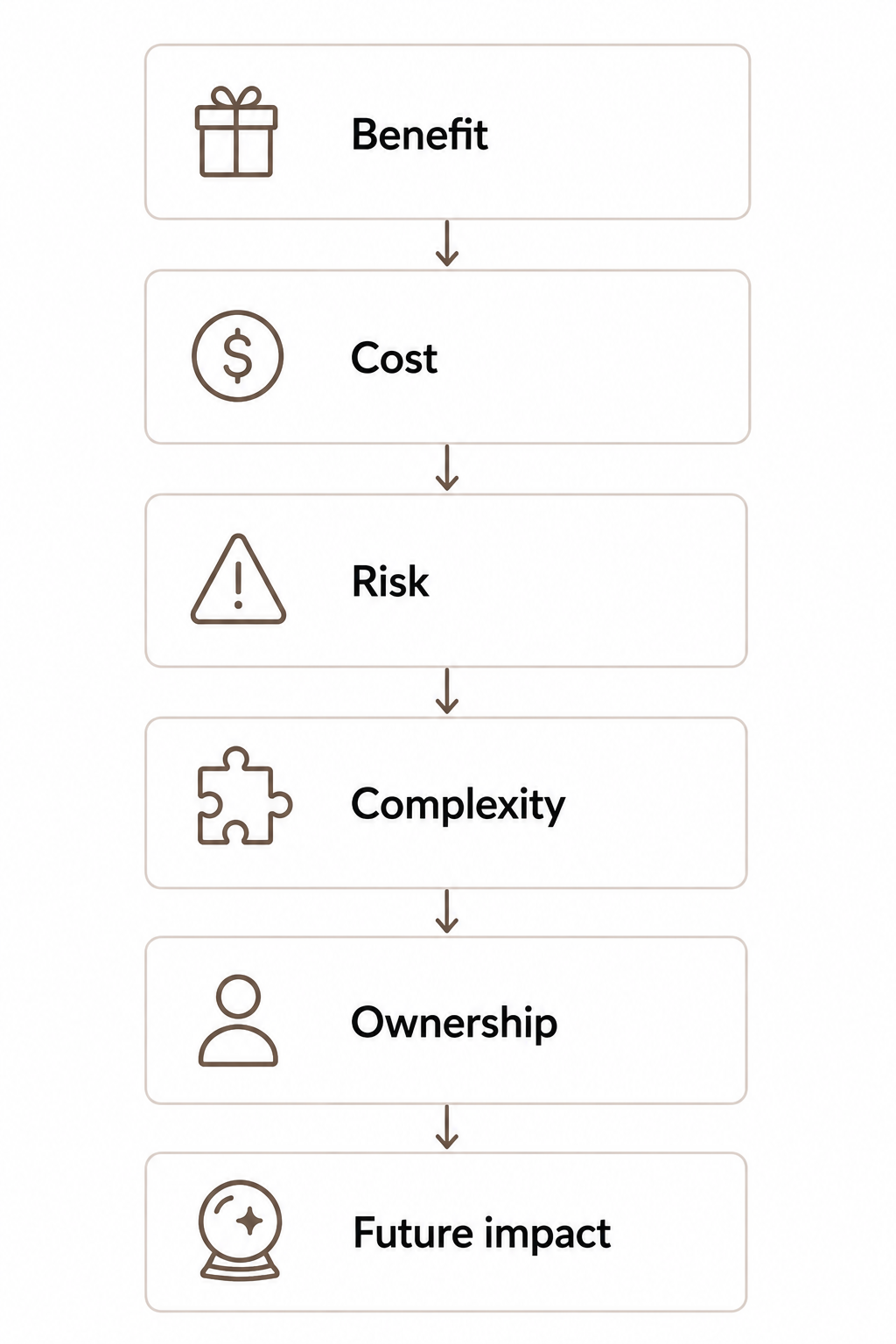
Trade-offs: benefit, cost, risk, complexity, ownership, future impact

Every decision has a cost.

I prefer making trade-offs explicit instead of pretending every solution has only benefits.

This makes choices easier to defend, easier to review and easier to revisit when business conditions change.

Common Patterns

Prefer composition over inheritance.

Reduce coupling before scaling.

Automate repetitive work.

Optimize after measuring.

Own fewer technologies.

Choose boring solutions.

What I Optimize For

Predictability

Maintainability

Operational simplicity

Fast delivery

Developer productivity

Business outcomes

Decisions I Made

✓ Platform architecture

✓ Event-driven migration

✓ Service decomposition

✓ Engineering standards

✓ Delivery pipeline

✓ Incident process

✓ Monitoring strategy

✓ Technology roadmap

Decision Philosophy

Good decisions reduce future work.

Architecture is a series of decisions.

Every dependency must justify itself.

Complexity compounds.

Reversible decisions move faster.

The best technology is the one nobody notices.

Good engineering is a consequence of good decisions.