Business before technology
Architecture
How I design systems that remain scalable, understandable and evolvable over time.
Architecture is not about choosing technologies. It is about creating systems that teams can safely evolve for years without losing speed.
Principles
Domain ownership
Event-driven communication
Loose coupling
Observability by default
Automation over manual work
How I Think
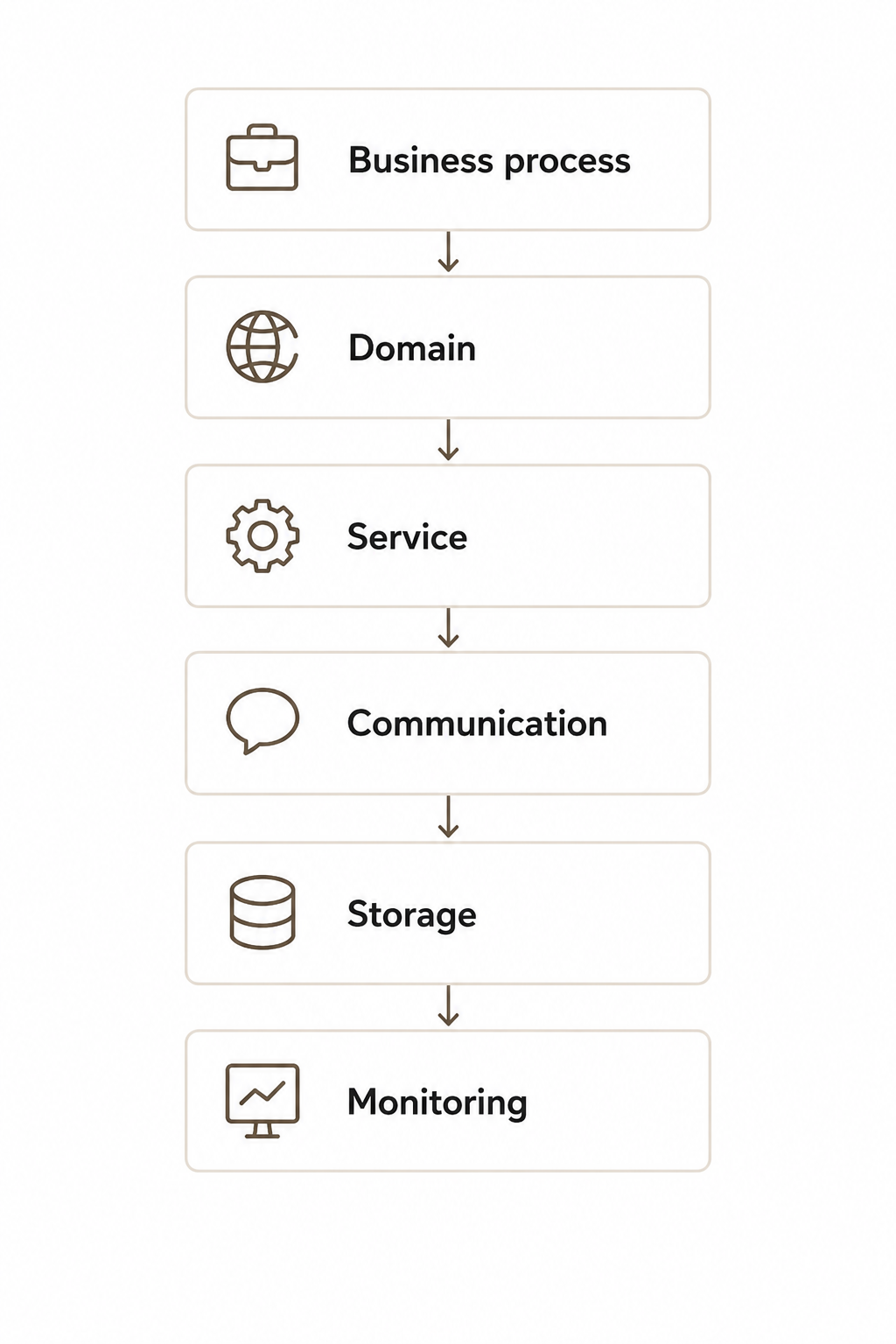
I never start from infrastructure.
I start from business capabilities, identify bounded contexts, define ownership and only then choose implementation details.
This keeps systems aligned with real operations instead of forcing business workflows to adapt to accidental technical choices.
Architecture Patterns
Event-driven
Independent services communicate through events to reduce coupling and improve flexibility.
CQRS
Separate reads and writes to simplify scaling and optimize each side for its workload.
Background Processing
Move heavy or delayed work out of synchronous flows to keep core operations responsive.
Caching
Store frequently accessed data closer to execution paths to reduce latency and database load.
Horizontal Scaling
Design services to grow by adding capacity across instances instead of relying on single nodes.
API-first
Define service boundaries through clear contracts so integration stays predictable over time.
Idempotency
Ensure repeated operations produce safe results when retries or duplicate events happen.
Retry Strategy
Handle transient failures deliberately instead of letting unreliable dependencies break flows.
Rate Limiting
Protect critical services by controlling request volume and preserving system stability.
Decision Framework
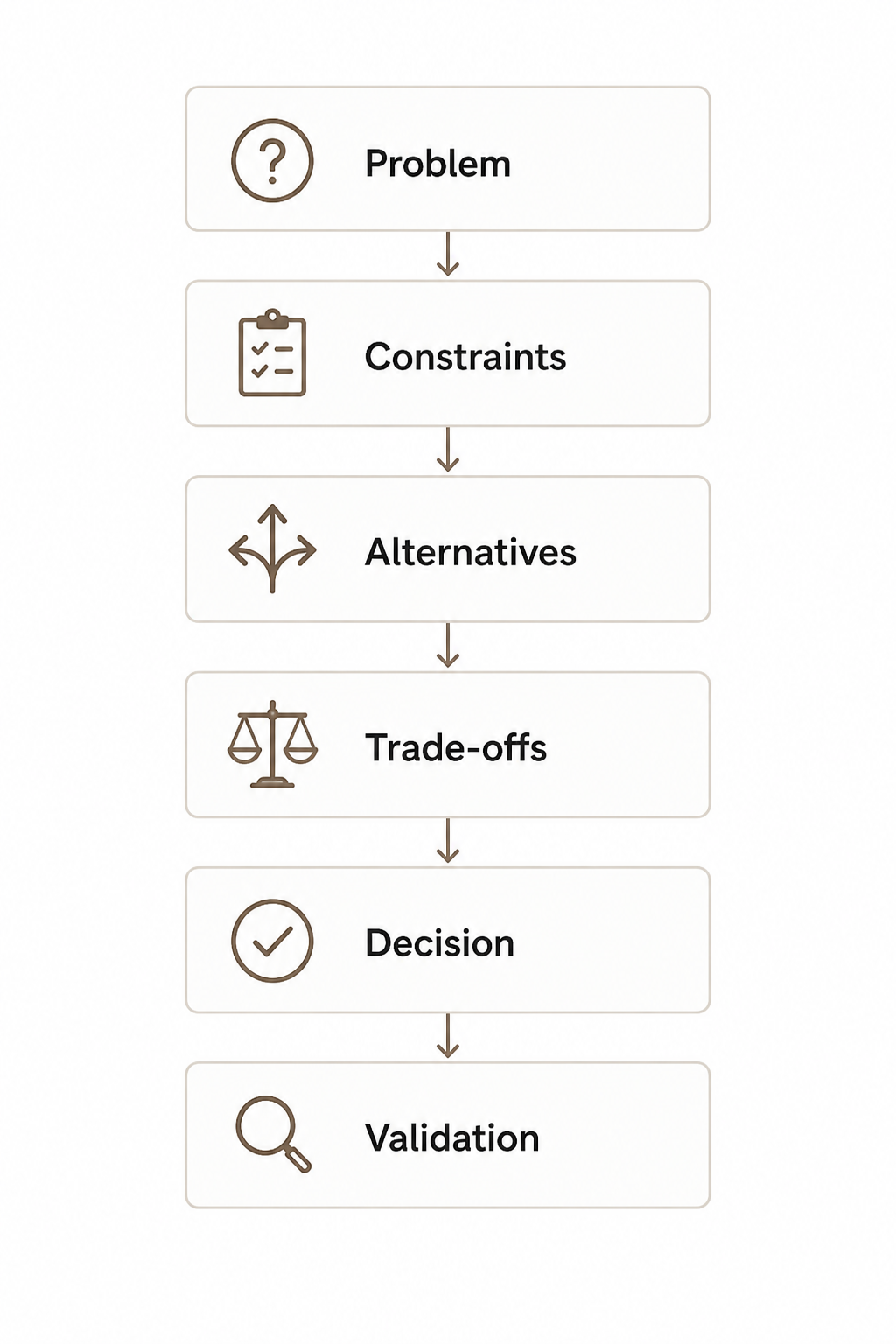
Every architectural decision follows the same framework.
No technology is selected because it is trendy. Every choice solves a measurable business problem.
This keeps decisions explicit, comparable and easier to validate as the platform evolves.
Architecture Philosophy
Architecture should reduce communication cost.
Technology is replaceable. Business processes are not.
Every dependency must justify its existence.
Simple systems survive longer.
Automation beats documentation.
Reliability is a feature.
Good architecture is invisible to business, predictable for engineers, and scalable for growth.